In the Neff FullSteam oven you have besides the oven function also a steam function. This function comes in handy if you need to make your rice. This time a video about how to make rice in your Neff FullSteam oven.
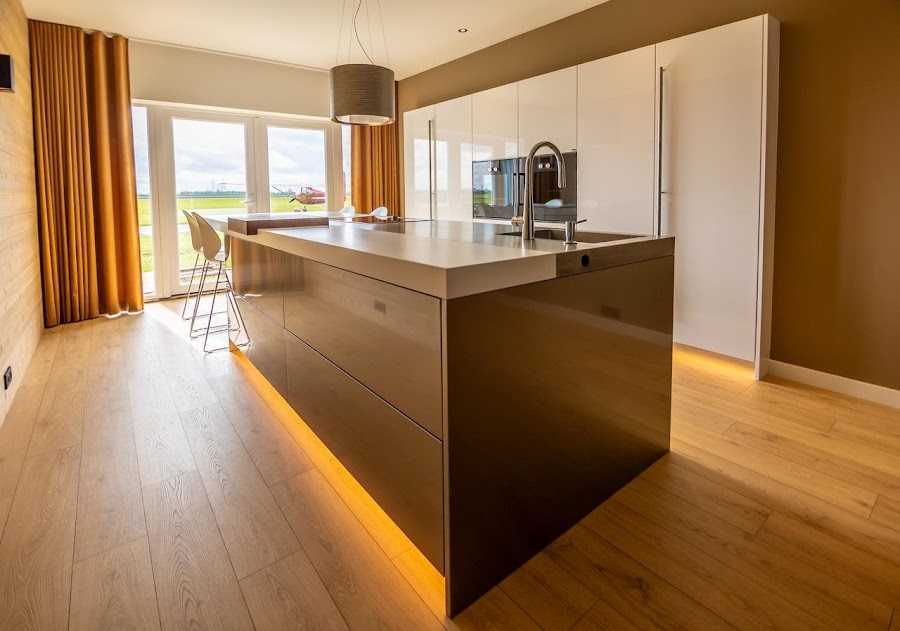
In my Snaidero kitchen showroom I have a kitchen on display in satined glass; the S13 composition.
The worktops in this kitchen are made from inox and Iroko wood. I`ve chosen for wood because it gives a warm effect on the "cool" materials like glass and stainless steel.
The appliances in the S13 kitchen are from the German brand Neff.
A couple of weeks ago I`ve put this kitchen on video, this video is embedded below.
This time again a blogpost (number 6) about the brand Snaidero. This post is about the future of kitchens according to Snaidero.
FUTURE IS INTELLIGENCE
SMART KITCHEN, INTERACTIVE AND RELATIONAL INTELLIGENCE REDESIGNS THE SPACE
“Smart”, i.e.: elegant and attractive, as well as creatively intelligent and interactive. The word smart has become an internationally-recognised modern and contemporary term. Today it represents above all a coherent collection of new values, with a profound meaning, able to radically redefine parameters of judgement with respect to terms such as "luxury" and "modern".
This is particularly true in the context of architecture and interior design. In these fields today there is a growing focus on eliminating waste, in a very broad sense, and with a lasting impact on culture and values. Today there is a growing desire for harmonisation and intelligent optimisation - becoming smart - which in turn informs the different categories that are closely linked to the world of design and manufacturing: space and time, ecology and economy.
And so in this way, profoundly revising the conventional concepts of furnishing, we are moving ever closer to new ways of interpreting the spaces in the home. Now occupied by completely flexible, adaptable and re-adaptable furniture. This means furniture that is easy to assemble, disassemble and reassemble, based on requirements or taste. All this must take place in the effort to reconnect the creative and aesthetic component of design with high technological and functional content on the basis of new conditions. In this way it becomes possible to conceive of and make truly contemporary products. Products that are coherently satisfying both in terms of form and aesthetics, functionality and design technology.
This is exactly what happens in kitchen spaces designed by Snaidero, thanks to intelligent solutions, excellent flexibility and quality of design, and during the course of daily use. And, no less important, Snaidero is competitive in terms of quality and accessible in terms of cost. If every project tackled with such an approach presents complexities at the outset, the aim is then to find an end solution that on the contrary is as simple as possible and able to be transformed and re-adapted to a new environment.
All Snaidero kitchen designs have a "smart" identity, in other words they are equipped with relational intelligence as well as a comfortable design. These are the principles behind the new kitchens on offer to the public now and in the future: “Orange”, “Way”, “Code”, “Board”, “Lux”, “Ola 20”. All of which are smart designs because they are intrinsically able to respond to the most contemporary expectations of quality, life, aesthetics and technology, right from the design stage. They are also all provided as standard with a potential for customisation and accessibility that has never been seen before.
The concept of the "smart kitchen" for Snaidero is linked to two aspects. The first is maximum freedom given to each compositional element to encourage and enhance the creativity, the taste and functional requirements of the user, both at the design stage and then during daily use. The second aspect, however, concerns the complex subject of the flexible and functional use of the kitchen space, above all with respect to small spaces. We are convinced that in a smart kitchen all the various requirements relate to one another and can find their perfect balance, which is always dynamic. In the end it is always about renovating and expanding, using new knowledge and new possibilities, the still extremely valid concept of "design for all". Or in other words "for life".
THE 2000s “UNIVERSAL DESIGN”
DESIGNING SPACES FREE FROM COMPLEXITY, THE PRODUCT ADAPTS TO THE INDIVIDUAL USER
In 2000, following the internationalisation policies adopted in the 1970s and '80s and the acquisition of other industrial businesses during the '90s, the “Snaidero Group” was born. The new Group's aptly chosen motto was “many diversities, a single large group”. The Group then looked at the international markets from the position of an industry leader, competing at all levels: in terms of finances, sales and design. It was exactly in these last two aspects, i.e. in the context of the most advanced new innovations brought forward by the international debate surrounding new architectural and industrial design paradigms, that the Group decided to innovate. Once again finding its cultural roots and entrepreneurial raison d'être in innovation.
Universal Design is a modern design methodology that aims to create environments which are universally accessible to all types of people, whether or not they have disabilities. Its ideal principles enhance the concept of human diversity, social inclusion and equal opportunities, providing solutions that are as easy to use and interact with and as flexible as possible.
And in this new context Snaidero was once again ready for the new cultural changes and technical challenges, making them its own. In 2002 the “Skyline_lab” project was created, which Snaidero assigned to two great architects and long-term collaborators Lucci and Orlandini. The project had the ambitious aim of going even further towards the specific requests of the customer base. And at the same to provide a useful service and support for disabled people and their families in the spirit of “Design for all”. An improvement in the level of autonomy and safety for disabled people in their home environment is reflected positively in their quality of life and that of their family members, who no longer need to provide assistance. This was the firm conviction that guided the Company's decision.
The project was built up around an extensive initial study. The needs of people with many different kinds of disabilities and motor problems were carefully studied and analysed on an experimental level. This is how, in the field, working directly with the beneficiaries of our efforts, we were able to identify the best solutions to provide a simpler, more comfortable and more effective way of interacting with the kitchen environment for all users. This is of course also fully in line with the design statement of intent to provide improved autonomy and safety. For example, by providing storage surfaces and building-in domestic appliances so that they are both always easily accessible.
The “Skyline_lab” represents a particularly flexible program, able to adapt to anyone's needs, by using diversified solutions. For example, pull-out shelves, useful for easily interacting with objects, or worktops made to measure for the person and not just made to measure for the space. Many of these needs are in fact common to most kitchen users, regardless of their physical condition or age. That which can be useful and essential for an old or disabled person, can and must therefore also be useful for everyone else.
Convinced of this idea, with “Skyline_lab” Snaidero decided to start a truly innovative kitchen project firmly rooted in the principles of “Design for all”. In other words the principles of a modern design and manufacturing process able to provide a relationship with its users that is both universal and personal at the same time.
This time again a blogpost about the history of Snaidero. This is part 4, and this part I am also kinda part of. As I was working with Snaidero from that time on. But if you want to read the earlier parts, it starts here.
THE 1990s NEW EXPERIMENTATION
THE COLLABORATION BETWEEN SNAIDERO AND PININFARINA BEGINS: THE GOAL? THE FUTURE
“I can safely say that I would never have designed kitchen cabinets if I hadn't been approached by Snaidero. We brought to the table a wealth of experience in formal aesthetics, recognised worldwide in the motor vehicle field. The meeting of ideas was found in the desire to see if we could translate our background of history and technological knowledge into designing a kitchen as if it were a machine for living in, i.e. form and function. And I must admit that Snaidero was at the cutting edge in every department”. This is how Paolo Pininfarina described the immediate understanding that clicked into place between his industrial design agency and Snaidero in 1990.
The statement of intent at the base of the prestigious collaboration between the two brands was to overcome the now standardised look that kitchens made by various different manufacturers tended to have at the time. The modular compositions were becoming more and more uniform and could almost only be distinguished from one another by the details: the type of handle, the treatment method for the doors, the finishes in laminate, lacquer or wood... So Rino Snaidero and Paolo Pininfarina decided to get past this, to start to listen again and to try to understand the new demands of the public. Then to respond to their demands with suitable products that fulfilled their new contemporary, functional and aesthetic needs.
This led to “Ola”, a design characterised by a strong architectural component and three-dimensional layout. This was an extremely innovative kitchen with a lean and contemporary design, at once dynamic and intimately classical. The absence of decorative frills and the extremely clean look plastically combined with the results of a profound study in ergonomics, creating maximum functionality. Everything - for example the hood, the sink and the storage capacity - was designed so that each individual element could be used correctly and easily, as with the overall whole. “Ola” was immediately a great success, with both the public and the critics. In addition to the flattering sales figures was the pride of seeing the design awarded the prestigious Chicago Athenaeum design award in 1996.
“Ola” was followed by another kitchen aptly named “Viva” (the red kitchen on the above picture). Here Snaidero and Pininfarina embarked on an intriguing and sensual journey into colours and materials. Materials such as glass and steel were used in an innovative and highly contemporary way. In this particular aspect the decisive contribution made by the Pininfarina studio, specialised in automobile design, came to the fore. The glass in the “Viva” wall units, for example, is curved like a windshield. It was created using techniques taken directly from automobile design. With “Ola” and “Viva” Snaidero brought a pleasant and empathetic line of kitchens to the market, in perfect synchrony with the Company claim: “Relax, it's a Snaidero”.
In the meantime, it was time to celebrate two important events, which were both extremely significant for the Company. In 1996 the Company celebrated its 50th anniversary. In the same year, this splendid anniversary was joined by another, the 75th birthday of Cavalier Rino Snaidero. He chose this moment to announce his well-deserved retirement, leaving the Company chairmanship to one of his sons, Edi, who was already chief executive officer.
Under the guidance of Edi, a mechanical engineer who had worked at the Company since 1984, Snaidero began another important period of development. Its internal structure was reorganised and optimised, strategic acquisitions of other companies were brought to a conclusion and the Company became even more focused on technological research. Last but not least, the Company's entire manufacturing process was globally certified according to the new European Regulations. Like father, like son...
Finally. The Ola kitchen is still in production but has got a restyling by mr. Pininfarina. I`ve embedded the video of the current Ola kitchen in my showroom below.
THE 1970s-’80s_ THE DESIGN ERA
SNAIDERO PLACES DESIGN AT THE CENTRE OF ITS COMPANY AND PRODUCT IDENTITY
At the end of the 1960s, the Company's visionary founder felt the need for a change in the manufacturing philosophy. The need to re-establish and consolidate the Company's relationship with the big names of Italian industrial design, which were astounding the world and creating a trend for everything “Made in Italy”. The innovative research being carried out and associated practical consequences for manufacture also meant that a wider audience was opening up. It would no longer be about a restricted circle of manufacturers catering to an elite customer base. The time had come to test the validity of those theoretical and practical advances on a wider and now more demanding public, "hungry" for new things and expressive and functional modernity.
During the same period, in 1973, Rino Snaidero also decided to extend his factory in Majano. Once completed in 1978, the expanded factory reached the size of one hundred thousand square metres, organically divided between the different manufacturing departments, warehouses, canteen and social areas. A "population" of one thousand three hundred people worked there. In addition the expanding Company opened three new sales subsidiaries: in Paris, London and Zurich.
Who designed the new and futuristic factory in Majano (picture above)? In 1975 Rino Snaidero, who in the meantime had been invested as a Knight of Industry, entrusted Angelo Mangiarotti – professor at the Institute of Technology in Chicago and renowned architect in Milan – with the design of the new Company headquarters. The courageous and enterprising entrepreneur and the celebrated and visionary architect immediately struck up a productive relationship based on mutual professional admiration and human charm. During the 1970s the architect was working on a series of mushroom-shaped blown glass vases: a design solution that was adopted on a construction level for the design of the new and imposing headquarters for Snaidero. The bold design solution proposed by Mangiarotti was resolved by the innovative choice of building the facade from fibreglass attached to a reinforced concrete structure supported by four columns. The result was a magnificent building with extremely refined materials and support structures, characterised by slightly protruding elliptical windows that became round in the curvature of the corners.
However, whilst the building site was still under development the unthinkable happened. All of Friuli and therefore also Majano (which was only five kilometres from the epicentre) was struck by a terrible earthquake on 6th May 1976. Rino was in Canada. He came back immediately, to his family, to his workers and to his factories. The latter he found destroyed, the former not much better off. The earthquake killed many and devastated homes and businesses. Rino did not lose hope however, and as if faced with a dramatic new post-war scenario, he motivated everyone to find courage and rebuild: “Do not give up, difficulties should be faced with determination...”. He then added: “When these big disasters strike of course we all need a corner to sleep in, but it is essential to rebuild the workplaces immediately and then the houses. If there is no work, there is little need for houses”.
And then from words he went straight into action. He immediately had the surviving machinery moved to the factory in Portogruaro, and from there, just ten days after the terrible earthquake, full production began once again. The contracts were saved and so, above all, was the future of his workers. Straight after this he called for the architect Angelo Mangiarotti, asking him to promptly continue with the works at the devastated building site. The new complex was completed in 1977 and featured avant-garde building solutions designed to withstand earthquakes.
However, Rino Snaidero did not want to miss the opportunity represented by his meeting with Angelo Mangiarotti to put forward another matter entirely. He asked him to design a kitchen, which would later become known as the “Cruscotto”, and which was the pure expression of a profound research in terms of materials and an equally advanced study of ergonomics. It immediately became the centre of attention, with a prototype of the new kitchen accepted and exhibited straight away at the MoMa in New York.
Subsequently in the 1980s the architect Giovanni Offredi became the main designer at Snaidero, with his excellent taste and sensitivity he was one of the best designers of his time. Over the years his pencil produced many refined and beautiful designs that became both public and critical successes. The splendid new “Krios”, “Kalia”, “Pragma”, “Elementi” and “Contralto” kitchens were thus created, all to varying degrees highly innovative and technological.
The kitchen on the picture above is model Kalia by the way. A timeless design what a bit looks like the S18 kitchen I`m selling nowadays (see embedded video below).
As I`m selling more and more kitchens abroad I`ll try to post an English written post sometimes too. This time the second part about the history of the brand Snaidero (click here for the first part) and click here for the third part.
Snaidero is a very old brand already, so this time a post about the history of Snaidero in the sixties.
THE 1960`s: THE BOOM
ITALY DISCOVERS THE MODULAR KITCHEN, SNAIDERO FLIES TO THE MOMA IN NEW YORK
At the very beginning of the 1960s, as we have seen, the Company became exclusively specialised in the design and manufacture of kitchens. And not just any kitchens, modern modular kitchens. 1961 therefore saw the launch of “Gloria”, the first modular kitchen in polyester lacquered wood made by Snaidero. The domestic appliances were built into the kitchen - a conceptual revolution! What were once simple storage units now became wonderfully equipped cabinets arranged around the contours of the room. The revolutionary product was completed by a version with a filtration hood.
Innovation often leads to further innovation. Rino soon realised that “Gloria” was a kitchen product with a potential market much bigger than the one the Company had managed up until then. Its creation and innovative content was therefore advertised using the new possibilities offered by the newly created mass media. This was already widespread, if not yet in peoples' homes, in public places all over Italy: Television. It was a 15 second television advert that then first brought the national public's attention to both the innovative kitchen called “Gloria”, and the dynamic brand named “Snaidero”.
The market's response also rewarded the innovation offered by this product and this soon transformed itself into a flattering portfolio of commissions. In the national and international context of the times - when films and music infected Europe from across the ocean, exporting what later went down in history as the “American Way of Life” - everything was moving euphorically towards the new and towards full economic development.
We said that the figure of the pioneer and entrepreneur is characterised by courage and foresight. Let's add intuition to this list of virtues. Rino Snaidero recognised the importance of the cultural changes taking place and anticipated their imminent consequences in terms of market trends. If America doesn't have the historical weight of the Old Continent, the History of America needs to be invented, thought Rino. So he dressed his furniture, which was already rational and modern, with the colours and suggestions of those endless grasslands and named it “Old America”.
The cabinets in the “Old America” range used practical compositions and modern built-in appliances, balancing this, however, with the search for warm and welcoming atmospheres. It was thus able to create the type of habitat that was most sought after, at that time, by a large section of the marketplace that was still distant from the tastes of avant-garde pure rationalism. The result was a hugely successful product, with no real competition or possible comparisons, which made use of the most innovative materials of the time, such as plastic laminates and composites.
However, as we have seen, even as early as the end of the 1950s Rino Snaidero was already convinced that times had changed and that the kitchen manufacturing industry would sooner or later have to encounter the world of the designers. In other words to make use of the theoretical and practical contributions offered by those brilliant professionals that were able to translate the now quite evolved needs of the consumer into splendid products. New well-being and new lifestyles, in part arising from influences arriving from across the ocean, gave rise to a new taste, even in home furnishing. The public was then gripped by an almost cultural and practical necessity to fully express its contemporary nature.
And so it was that in 1968 the great architect and designer Virgilio Forchiassin designed the “Spazio Vivo” kitchen for Snaidero. It was an extraordinary and innovative product, able to interpret its customers' new demands and to set out new lifestyle scenarios. The hob and sink were designed according to a revolutionary new concept: they were grouped into an island – for the first time ever! – and given the name “central block”. The remaining functions are assigned to the wall space using innovative moving blocks which, hinged to the base units, open and close according to the function they are designed to perform. This is when the unthinkable happened. On its debut, the Snaidero “Spazio Vivo” kitchen immediately entered the permanent collection of the prestigious “MoMa” (Museum of Modern Art) in New York, an international temple to avant-garde design.
Every well-made cake needs a bright red cherry to finish it off however, and this is also true of other more complex situations. And so it was that after a period of dazzling and exciting growth, Rino Snaidero had the satisfaction of seeing his Company listed on the Stock Exchange. What was once a small craft workshop with big dreams for the future, became “Snaidero Rino S.p.a.” in 1969.
Finally. Besides English written blogposts I`m making English spoken video`s nowadays too (excuse me that my English is not perfect but I`m working on it). Above is a video embedded of the Ola 20 kitchen in my showroom.
I have made a Dutch spoken video of this kitchen last year, but until now I did not have the English version. The English spoken video is now ready too and I`ve embedded the video below.
For next week we`ve to deliver 3 Snaidero kitchens in the UK. One of those clients has bought a high pressure steamer (Snaidero kitchen project 703 in Camberley/Surrey). For this client we`ve made the video I have embedded below (my apologies for my English, I`m working on it).
Mussels in the high pressure steamer.
The builders of the house of project 703 are running a little behind. That is why the installation of that kitchen is planned later this year.
As I am selling more and more kitchens in the UK more clients are asking for English spoken video`s. This time a video about how to steam rice in the high pressure steamer.
As I`m selling more and more kitchens abroad I`m trying to post an English written post sometimes too. This time the first part about the history of the brand Snaidero: the beginning (click here for the second part).
THE 1940s-'50s_THE RECONSTRUCT
RINO SNAIDERO BEGINS A GREAT BUSINESS AND FAMILY SUCCESS STORY
Soon after a devastating war for Europe and the Friuli region, few had the strength and courage to look beyond the rubble. Even fewer where able to plan for the future. Amongst these post-war pioneers we have Rino Snaidero, an uncompromising native of Friuli. This young man decided to take up the challenge and take what became the gamble of a lifetime.
A gamble not based on luck, but rather on intelligence and manual skill: on the virtue of work, in other words. And so it was that in January 1946 Rino did for the first time what he would continue to do throughout his long life: breaking with tradition by innovating. He broke with the family tradition and chose to become a craftsman and furniture maker. He did this by setting up and opening his workshop behind his father's house, in Deveacco, near Majano (Province of Udine). Significantly, on the 9th March of the same year he got married, thus also beginning his own family.
At this point Rino was struck by the desire to create jobs and stable and peaceful prospects for his fellow countrymen, and a future for his children. Without running the risk – which in those days was almost inevitable – of seeing them leave (both fellow countrymen and children) to take the difficult road of emigration. In this way, business and family interests coincided.
Rino employed sixteen people in his first workshop. In the beginning the Company only made bedroom furniture, and later also windows for the new homes being built, taking advantage of the opportunities offered by the “Ina Casa” program. Soon the workshop was no longer big enough. A new building was erected on the site of his father Francesco's vegetable garden, and in here were housed new machines that allowed him to further refine the manufacturing process. A process which, from craft beginnings, now became decidedly more industrial by the introduction of serialization. A house was rented in Deveacco di Majano (Udine), and was used to house the first permanent display of the Company's products.
In 1959, a crucial year in the Company's history and development, Rino made three very important decisions. He set up “Rino Snaidero & C.”, transforming what was essentially still just a workshop into a properly structured business. He settled once and for all on the manufacture of kitchen furniture exclusively, optimising and serialising the production lines in an industrial way. He invested his savings in a hectare of land in Majano (Udine), in what was then called viale Europa Unita and is now named viale Rino Snaidero Cavaliere del Lavoro (Cavaliere del Lavoro - literally Knight of Industry - is an Italian decoration given to important figures in industry). It was here, later, on 9th January 1960, that the Company's new industrial premises were opened.
If it is true that the virtues of an entrepreneur and pioneer must include foresight as well as courage, Rino Snaidero quickly understood the changes taking place and the evolving times and tastes. Just a few years after the war he realised that bedroom furniture was no longer a growth area. It was the first American kitchens, the new modular designs he had glimpsed in magazines, which then captured his imagination. The first domestic appliances were already revolutionising the conventional order of the kitchen space. The kitchen, thought Rino, will now have to be reorganised according to a new order and a new anthropological ideal. This challenge therefore came to represent for him, the newest, most interesting and most lucrative commercial and research frontier to dedicate himself to from then on.
Finally. Besides English blogposts I have started to make English spoken video`s too (like the embedded video above). Unfortunately my English is not perfect, my apologies for that.
This morning I had a question about the RJ type hood I usually sell. I have this question more often, so it is more convenient to explain it on my blog for the English clients (this client came from Surrey).
The hood itself is a built-in type hood with width 90cm. The hood is made from white glass. This is easier to clean compared to stainless steel. The engine of this hood has 3 speed levels and a power function. There is also fluorescent lighting and an indicator for the grease filter.
I usually send the hood to my clients by post in advance. Good thing I can open the hood of my car, because it`s a rather big box :).
I sell this hood with two extra kits. One of these kits is for the remote control.
The other kit you need to remove the engine from the hood and to install it on distance. I do this to reduce the noise of the hood, but also to lower the height of the lowered ceiling.
Usually we install the engine (size approx. 30x30cm) above the tall units. But of course, it is possible to install the engine also further away from the kitchen. Like in the garage.
I know the engine seldom gives problems, but it might be handy to install the engine in a way you can access it in case of a service.
On the video below you can see a S100 kitchen with this RJ type hood.
Finally the technical data below:
Width: 90 cm
Dimensions (WxDxH): 860x301x359 mm
Cut-out: 845x286 mm
Recirculation: Optional
Maximum flow: 785 m³/h
flow/pressure - speed level 1: 191 m³/h / ... Pa
Flow/pressure - Speed level 2: 281 m³/h / ... Pa
Flow / pressure - Speed level 3: 456 m³/h / ... Pa
flow/pressure - Power speed level: 629 m³/h / 547 Pa
Sound level 1(soundcapacity/acoustic pressure): 39 dB(A) re 1 pW / 29 dB(A)
Sound level 2 (soundcapacity/acoustic pressure): 47 dB(A) re 1 pW / 37 dB(A)
Sound level 3 (soundcapacity/acoustic pressure): 58 dB(A) re 1 pW / 48 dB(A)
Sound level Power (soundcapacity/acoustic pressure): 53 dB(A) re 1 pW / 52 dB(A)
Number of speed levels: 3+Power
Diameter exhaust: 150 mm
Type of lamps: 2 x TL8
Type of control: Electronical
Type of command: Touch Control
Number of metal grease filters: 1
Total max. consumption: 267 W
Energy efficiency index (class): C
Annual energy consumption (kWh/year): 99
Fluid Dynamic Efficiency (class): B
Light efficiency (class): E
Grease filter efficiency (class): C
Consumption in stand-by mode Ps (W): 0,3
As I`m selling Snaidero kitchens in the UK more often (like yesterday in Manchester) I`ve started to make video`s in English too. I know my English is not perfect (sorry). I`m working on it :).
Vandaag had ik klanten uit Engeland op bezoek (Manchester). Vanmorgen vroeg heb ik ze opgehaald van het vliegveld in Brussel (m`n vrouw heeft toen even opgepast op de winkel). Voor hun nieuwe Snaidero keuken wilden ze graag meer weten over keukenapparaten zoals bijvoorbeeld de hoge drukstoomoven.
Daarom ben ik eerst met ze naar Yerseke geweest om verse mosselen op te halen bij de Roem van Yerseke. De klant heeft ook gelijk Hollandse nieuwe geprobeerd (ze hebben ook een leuke viswinkel naast de "mosselfabriek" van de Roem van Yerseke).
Aangekomen in de showroom heb ik de mosselen voor ze klaar gemaakt. Heel simpel hoor, gewoon 1 minuut in de gaatjespan (hier boven de video die ik over de mosselen gemaakt heb). Naast de mossels hebben we natuurlijk nog meer dingen geprobeerd met de stoomoven zoals varkenshaas, aardappelen en groente.
De offerte voor de nieuwe keuken heb ik inmiddels weer aangepast. Het was heel gezellig en daarnet heb ik de klanten weer terug gebracht naar Brussel.